

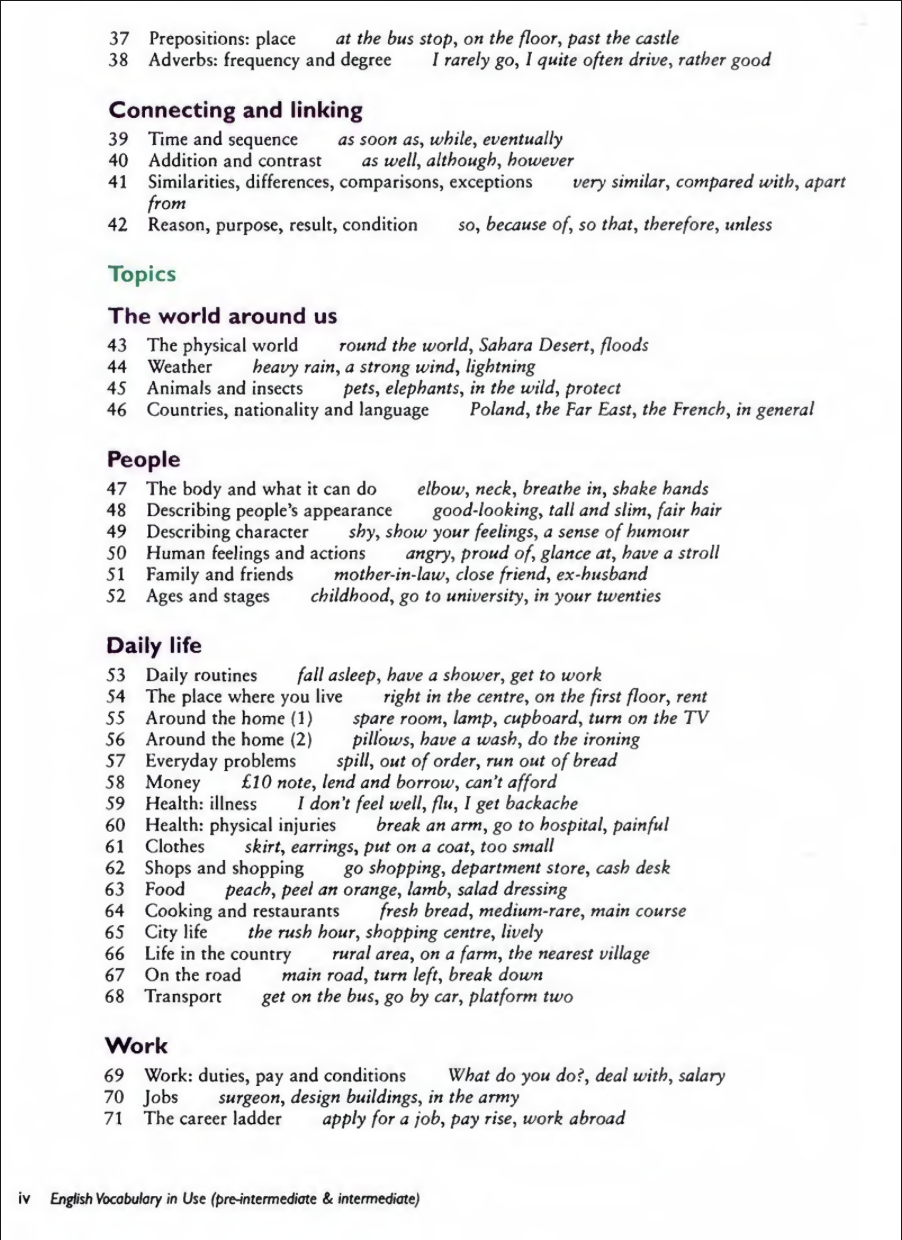
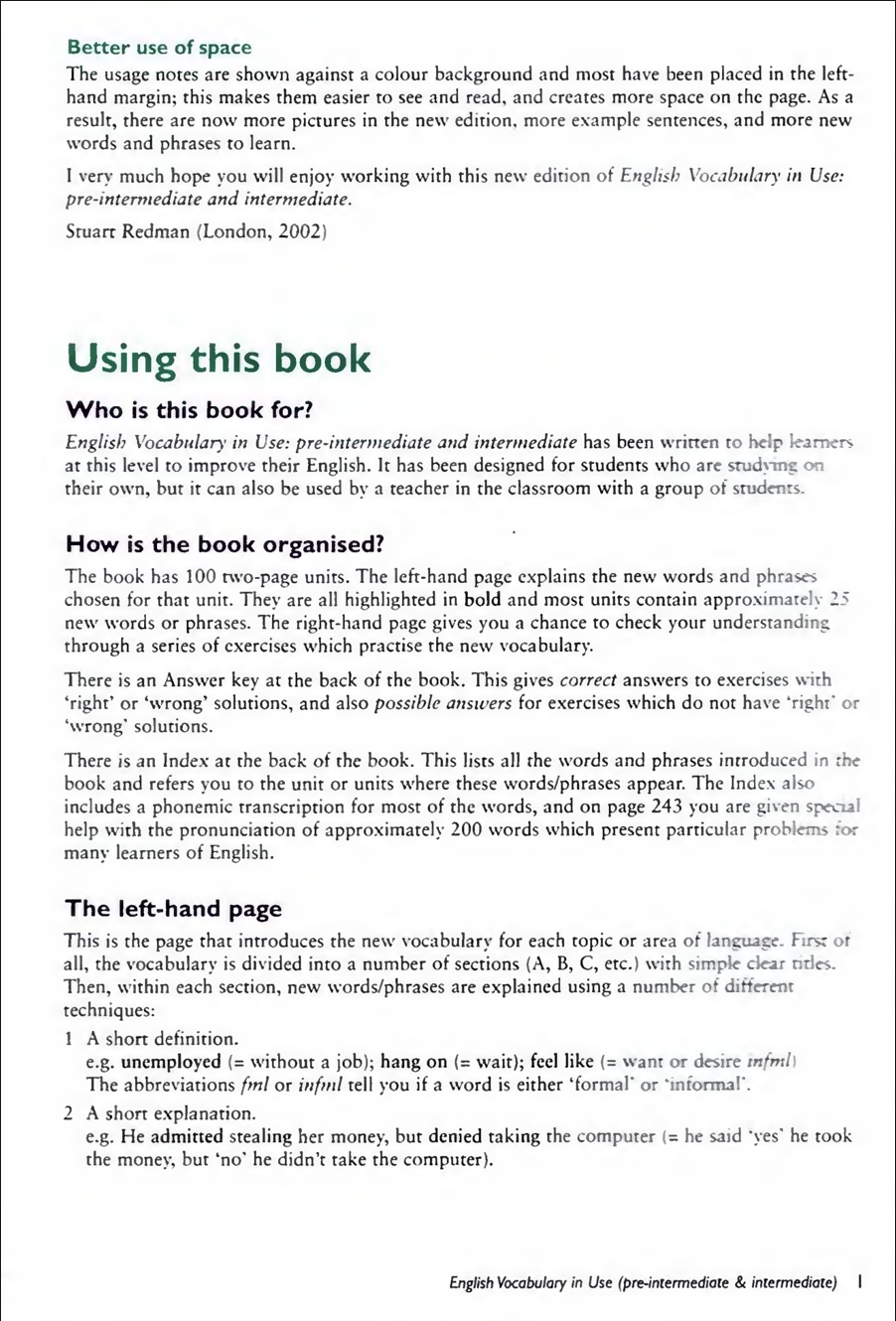


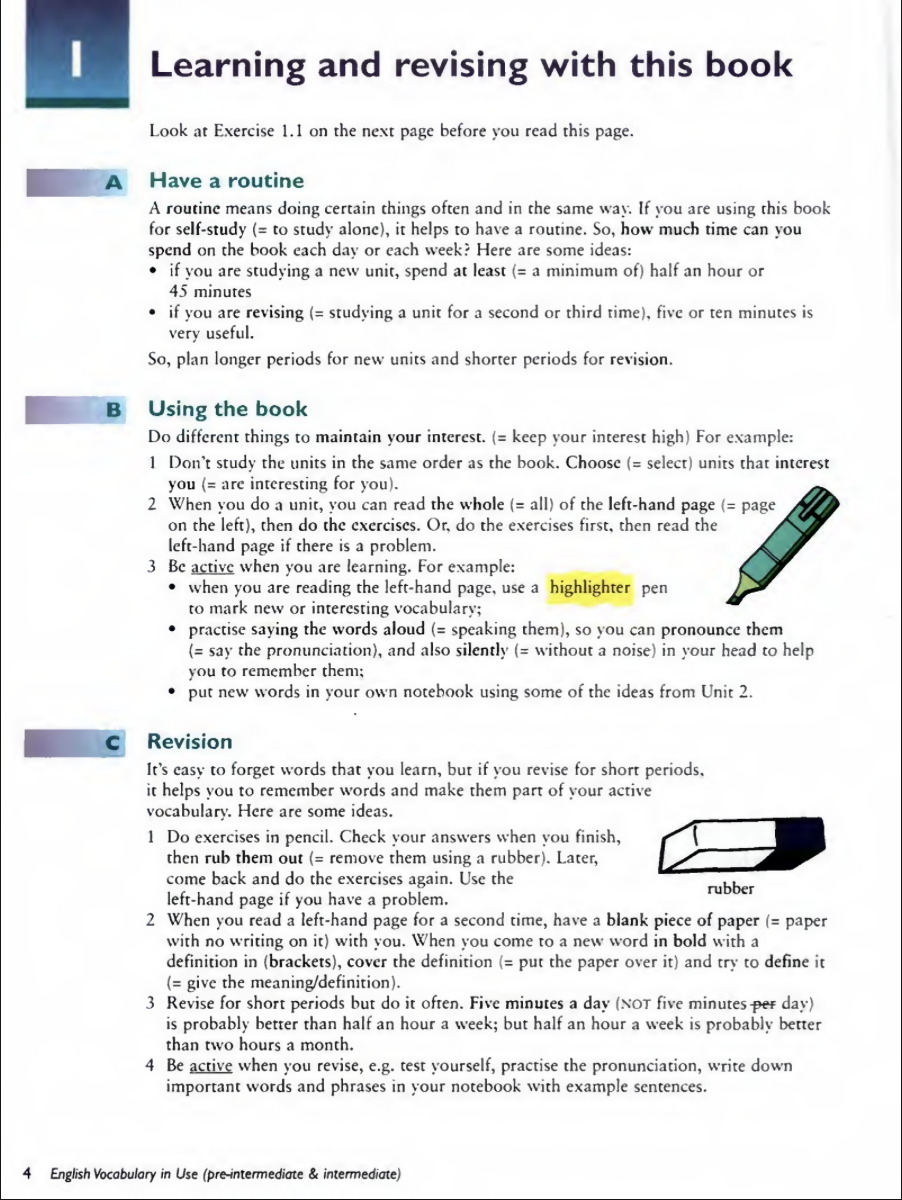

English Vocabulary In UsePre-Intermediate And Intermediate Second EditionStuart Redman Introduction viUsing this book 1Learning1 Learning and revising with this book2 Keeping a vocabulary notebook3 Using a dictionary4 English language words5 Classroom languageWord formation6 Prefixes7 Noun suffixes8 Adjective suffixes9 Nouns and verbs with the same form10 Compound nouns11 Compound adjectivesPhrase building12 Collocation (word partners)13 Idioms and fixed expressions14 Verb or adjective + preposition15 Preposition + noun16 Apologies, excuses and thanks17 Requests, invitations and suggestions18 Opinions, agreeing and disagreeing19 Likes, preferences and interests20 Frequently asked questions21 Common responses22 Greetings, farewells and special expressions23 Phrasal verbs (1): form and meaning24 Phrasal verbs (2): grammar and style25 Have and have got26 Make, do and take27 Give, keep, break, see28 Leave, catch and let29 Get: uses and expressions30 Go: uses and expressions31 The senses32 Partitives: a bag of …, a bit of …Parts of speech (special problems)33 Uncountable nouns and plural nouns34 Verbs + -ing form or infinitive35 Verb patterns36 Adjectives37 Prepositions: place38 Adverbs: frequency and degreeConnecting and linking39 Time and sequence40 Addition and contrast41 Similarities, differences, comparisons, exceptions42 Reason, purpose, result, conditionTopics: The world around us43 The physical world44 Weather45 Animals and insects46 Countries, nationality and languagePeople47 The body and what it can do48 Describing people’s appearance49 Describing character50 Human feelings and actions51 Family and friends52 Ages and stagesDaily life53 Daily routines54 The place where you live55 Around the home (1)56 Around the home (2)57 Everyday problems58 Money59 Health: illness60 Health: physical injuries61 Clothes62 Shops and shopping63 Food64 Cooking and restaurants65 City life66 Life in the country67 On the road68 TransportWork69 Work: duties, pay and conditions70 Jobs71 The career ladder72 In the office73 Business and financeLeisure and entertainment74 Sport: ball games75 Sport and leisure76 Cinema and theatre77 MusicCommunication and technology78 Newspapers79 Television80 On the phone81 Computers and the InternetSocial concerns82 Education: school83 Education: university84 Law and order85 Crime86 Politics87 Bureaucracy88 Global problemsTourism89 Air travel90 Hotels and restaurants91 A sightseeing holiday in the city92 Holidays by the seaNotional concepts93 Time94 Numbers95 Distance, size and dimension96 Shapes, colours and patternsVarieties of English97 Notices and warnings98 Vague language99 Formal and informal English100 Abbreviations and abbreviated wordsAnswer key 204Phonemic symbols 242Pronunciation problems 243Index 244Acknowledgements 263 |
The Vocabulary Catalyst: A Comprehensive Review of the Strategic Language Mastery Series
Introduction: Engineering Success in American English Communication
In the journey toward professional-grade English, the transition from basic communication to nuanced fluency is often the most difficult leap. “The Vocabulary Catalyst” is a masterfully designed pedagogical roadmap specifically engineered to guide students through this threshold.
This curriculum moves beyond simple rote memorization, transforming the study of American English into a series of masterable, high-interest milestones.
What Kind of Book Is This?
This is a Comprehensive Thematic Discussion and Social Literacy Curriculum for intermediate to advanced English learners. It functions as a multi-disciplinary reference guide that bridges the gap between technical grammar and functional fluency.
The book follows a logical, modular architecture—sequencing 100 strategic lessons—ensuring that students build a cohesive understanding of how English functions as the operating system for their professional ambitions and social life.
Who Is the Ideal Reader?
- The Academic High-Achiever: Students who need to master the mechanics of “Phrase Building” and “Word Formation” for university-level excellence.
- The Global Professional: Individuals seeking an authoritative framework to master American English workplace interactions, from “Business and Finance” to “The Career Ladder.”
- The Lifelong Learner: Those who want to eliminate the “language gap” by understanding the subtle differences between “Formal and Informal English” and “Vague Language.”
Detailed Editorial Review: Why This Book Is a Game-Changer
1. Strategic Thematic Scaffolding
The standout feature of this manual is its Semantic Progression. It understands that for learners, engagement is the precursor to retention. By starting with the immediate self (“Learning”) and masterfully scaffolding up to complex societal systems (“Social Concerns,” “Global Problems”), the book ensures that the student develops a strong auditory-to-visual connection before being challenged by advanced abstract concepts.
2. Mastery of Practical and Situational Literacy
Unlike generic workbooks, this guide excels in Functional Accuracy. Lessons on “Phrase Building” (Collocations, Idioms, and Phrasal Verbs) provide the definitive solution to the “social gap” often felt by non-native speakers. It teaches students to navigate professional and social hierarchies in English, transforming abstract grammar into an essential tool for personal agency.
3. The “Phrase Building” Consolidation System
The curriculum is designed with Knowledge Retention at its core. The intensive focus on how words work together (Units 12-32) is a brilliant pedagogical asset. These modules provide the definitive solution to the “robotic English” syndrome, allowing students to produce natural, flowing sentences with professional-grade scrutiny.
4. Cross-Curricular Thematic Depth
The curriculum respects the power of “World Knowledge.” By integrating diverse themes—ranging from “The Physical World” and “Politics” to “Communication and Technology”—the manual effectively doubles the educational impact of every study session. Students aren’t just learning “how” to speak; they are learning about the world through the lens of a new language.
The Final Verdict: Why You Must Read It
Confidence is the foundation of authority. For any serious learner, the English language is a journey of 100 strategic leaps toward independence; this guide ensures that every one of those leaps is meaningful, measurable, and deeply enjoyable. If you are serious about building a literate, curious, and globally confident voice, this series is an indispensable investment.
Conclusion Rigorous, logically organized, and profoundly practical, this is the gold standard for modern vocabulary instruction. It celebrates the joy of discovery while maintaining a high standard of academic excellence. This guide is your primary resource for achieving communicative mastery.