
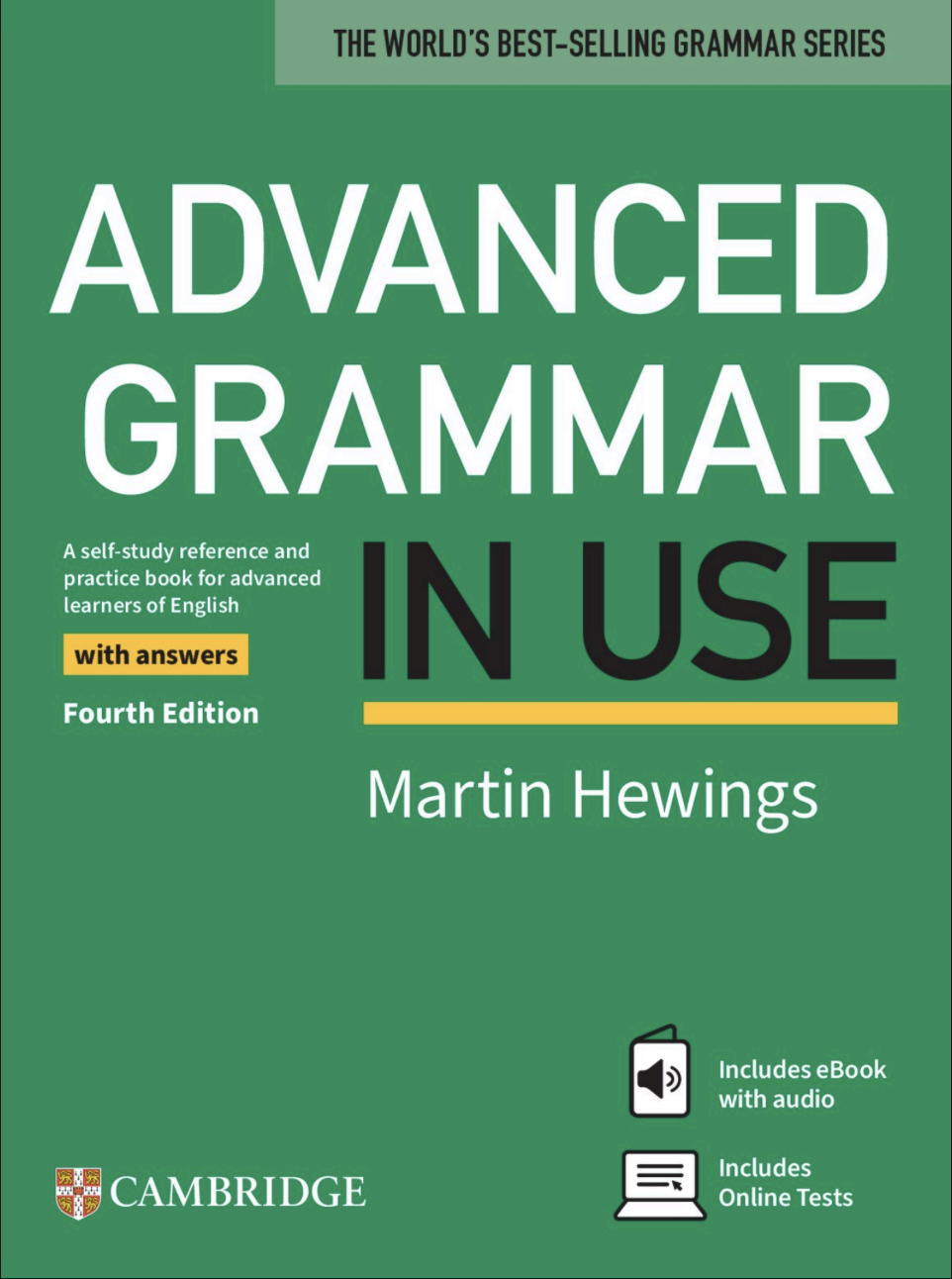
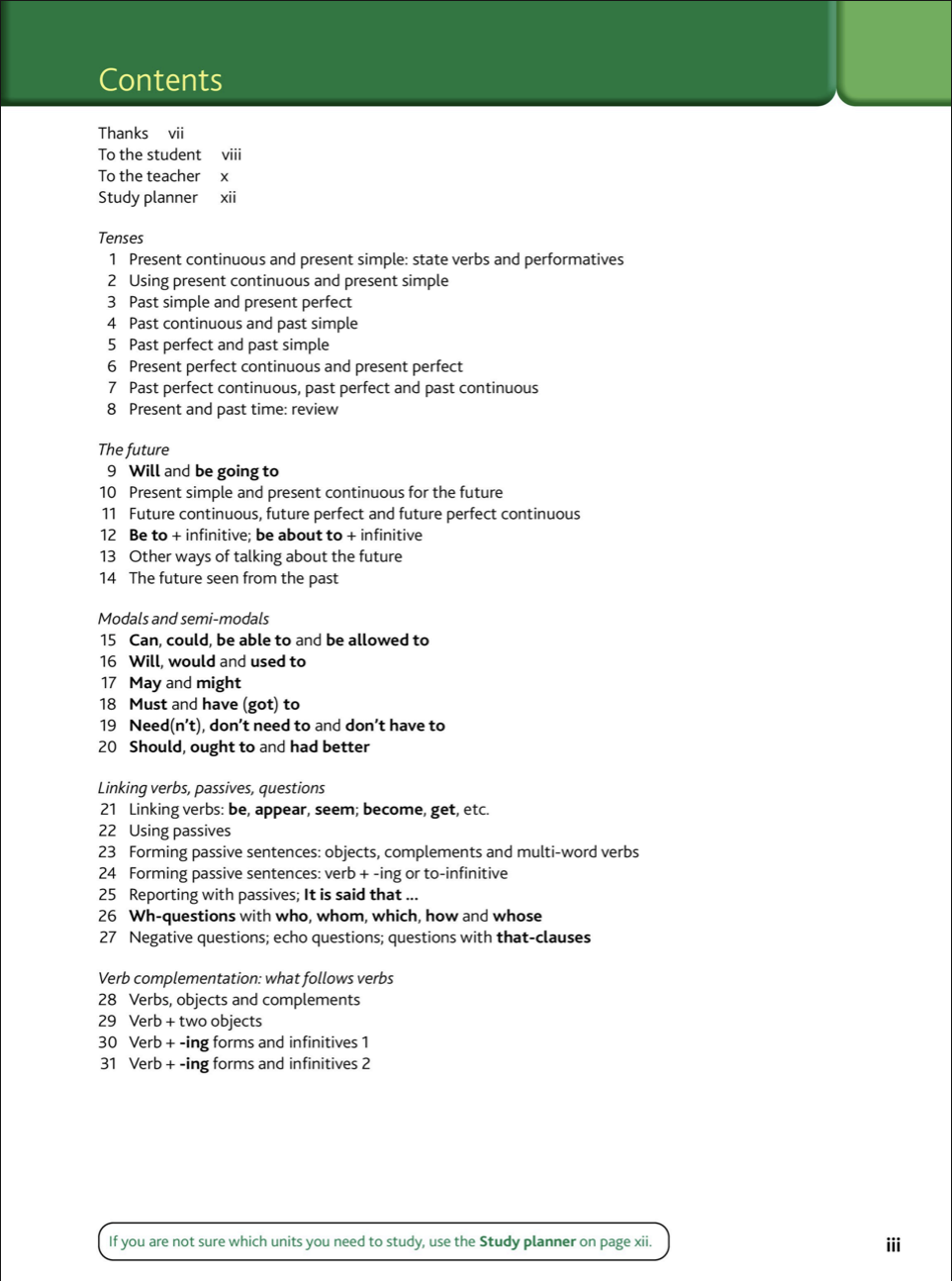



Advanced Grammar in Use 4th EditionMartin Hewings Thanks vii To the student viii To the teacher x Study planner xii Tenses1 Present continuous and present simple: state verbs and performatives 2 Using present continuous and present simple 3 Past simple and present perfect 4 Past continuous and past simple 5 Past perfect and past simple 6 Present perfect continuous and present perfect 7 Past perfect continuous, past perfect and past continuous 8 Present and past time: review The future9 Will and be going to 10 Present simple and present continuous for the future 11 Future continuous, future perfect and future perfect continuous 12 Be to + infinitive; be about to + infinitive 13 Other ways of talking about the future 14 The future seen from the past Modals and semi-modals15 Can, could, be able to and be allowed to 16 Will, would and used to 17 May and might 18 Must and have (got) to 19 Need(n’t), don’t need to and don’t have to 20 Should, ought to and had better Linking verbs, passives, questions21 Linking verbs: be, appear, seem; become, get, etc. 22 Using passives 23 Forming passive sentences: objects, complements and multi-word verbs 24 Forming passive sentences: verb + -ing or to-infinitive 25 Reporting with passives; It is said that … 26 Wh-questions with who, whom, which, how and whose 27 Negative questions; echo questions; questions with that-clauses Verb complementation: what follows verbs28 Verbs, objects and complements 29 Verb + two objects 30 Verb + -ing forms and infinitives 1 31 Verb + -ing forms and infinitives 2 Reporting32 Reporting people’s words and thoughts 33 Reporting statements: that-clauses 34 Verb + wh-clause 35 Tense choice in reporting 36 Reporting offers, suggestions, orders, intentions, etc. 37 Modal verbs in reporting 38 Reporting what people say using nouns and adjectives 39 Should in that-clauses; the present subjunctive Nouns40 Agreement between subject and verb 1 41 Agreement between subject and verb 2 42 Agreement between subject and verb 3 43 Compound nouns and noun phrases Articles, determiners and quantifiers44 A / an and one 45 A / an, the and zero article 1 46 A / an, the and zero article 2 47 A / an, the and zero article 3 48 Some and any 49 No, none (of) and not any 50 Much (of), many (of), a lot of, lots (of), etc. 51 All (of), whole, every, each 52 Few, little, less, fewer Relative clauses and other types of clause53 Relative pronouns 54 Other relative words: whose, when, whereby, etc. 55 Prepositions in relative clauses 56 Other ways of adding information to noun phrases 1: additional noun phrases, etc. 57 Other ways of adding information to noun phrases 2: prepositional phrases, etc. 58 Participle clauses with adverbial meaning 1 59 Participle clauses with adverbial meaning 2 Pronouns, substitution and leaving out words60 Reflexive pronouns: herself, himself, themselves, etc. 61 One and ones 62 So and not as substitutes for clauses, etc. 63 Do so; such 64 More on ellipsis after auxiliary verbs 65 Ellipsis of to-infinitives |
Mastering the Nuances of English: A Review of the Definitive Guide to Advanced Grammar
For most English learners, reaching a point of “functional fluency” is an achievement, but staying there is a trap. To truly excel in high-level professional, academic, or social circles, you need more than just vocabulary—bạn cần sự chính xác tuyệt đối (absolute precision). This book is designed to be the bridge between being “understood” and being “authoritative.”
What Kind of Book Is This?
This is a High-Level Grammar Reference and Practice manual specifically engineered for advanced learners. Unlike standard textbooks that focus on basic sentence construction, this volume explores the “architecture” of the English language. It tackles the subtle nuances, stylistic choices, and complex exceptions that define sophisticated communication. Organized into 100 concise units, it functions as both a systematic training course and a lifetime reference tool.
Who Is the Ideal Reader?
This book isn’t for everyone—it is a specialized tool for those who take their communication seriously:
- The Exam Candidate: An essential resource for those aiming for top-tier scores in IELTS (7.5+), TOEFL, or Cambridge C1/C2 exams.
- The Global Professional: Business leaders, lawyers, and researchers who need to draft high-stakes reports or lead international negotiations with total confidence.
- The Academic: Students in English-speaking universities who must master complex reporting and information-organizing structures to succeed in their studies.
- The Educator: A “must-have” for teachers who need clear, logical explanations for the most challenging questions advanced students ask.
Detailed Editorial Review: Why This Book Stands Out
1. Precision Over Basic Rules
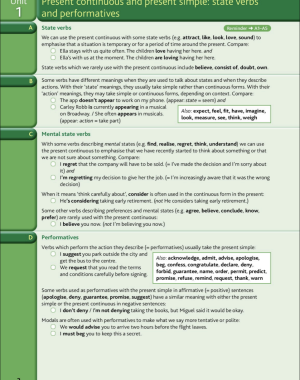
Most books tell you how to form the “Past Perfect.” This book explains why you would choose it over the “Past Simple” to change the focus of a story. It dives into the “gray areas”—such as the specific use of state verbs, performatives, and the future seen from the past. This focus on nuance helps you move away from “textbook English” and toward the natural flow of a native speaker.
2. Mastering the Art of “Reporting” and “Framing”
One of the most valuable sections covers Reporting and Verb Complementation. In professional environments, how you attribute information is critical. By mastering passive reporting (“It is said that…”) and specialized that-clauses, you learn how to sound objective, diplomatic, and authoritative. This is where “grammar” meets “strategy.”
3. The Secret to Native Fluency: Ellipsis and Inversion
What makes a native speaker sound natural? It’s often what they don’t say. The units on Ellipsis (leaving words out) and Substitution are game-changers. Furthermore, the lessons on Inversion and Information Organization teach you how to restructure sentences to emphasize key points, a skill that is vital for persuasive writing and public speaking.
4. Strategic Learning with the Study Planner
The author recognizes that advanced learners have limited time. The inclusion of a comprehensive Study Planner allows you to self-diagnose your weaknesses. Instead of wasting time on what you already know, you can pinpoint exactly which of the 100 units require your attention, ensuring a high return on your study time.
The Final Verdict: Why It’s Worth Your Time
You should read this book because it treats English as a professional craft rather than a school subject. It provides the “logic” behind the language, giving you the “X-ray vision” to decode complex academic journals and the tools to produce flawless prose.
If you are ready to eliminate those small, persistent errors and start communicating with the sophistication and confidence of a native professional, this is an indispensable investment. It is, quite simply, the “Gold Standard” of English grammar—and likely the last grammar book you will ever need to buy.