

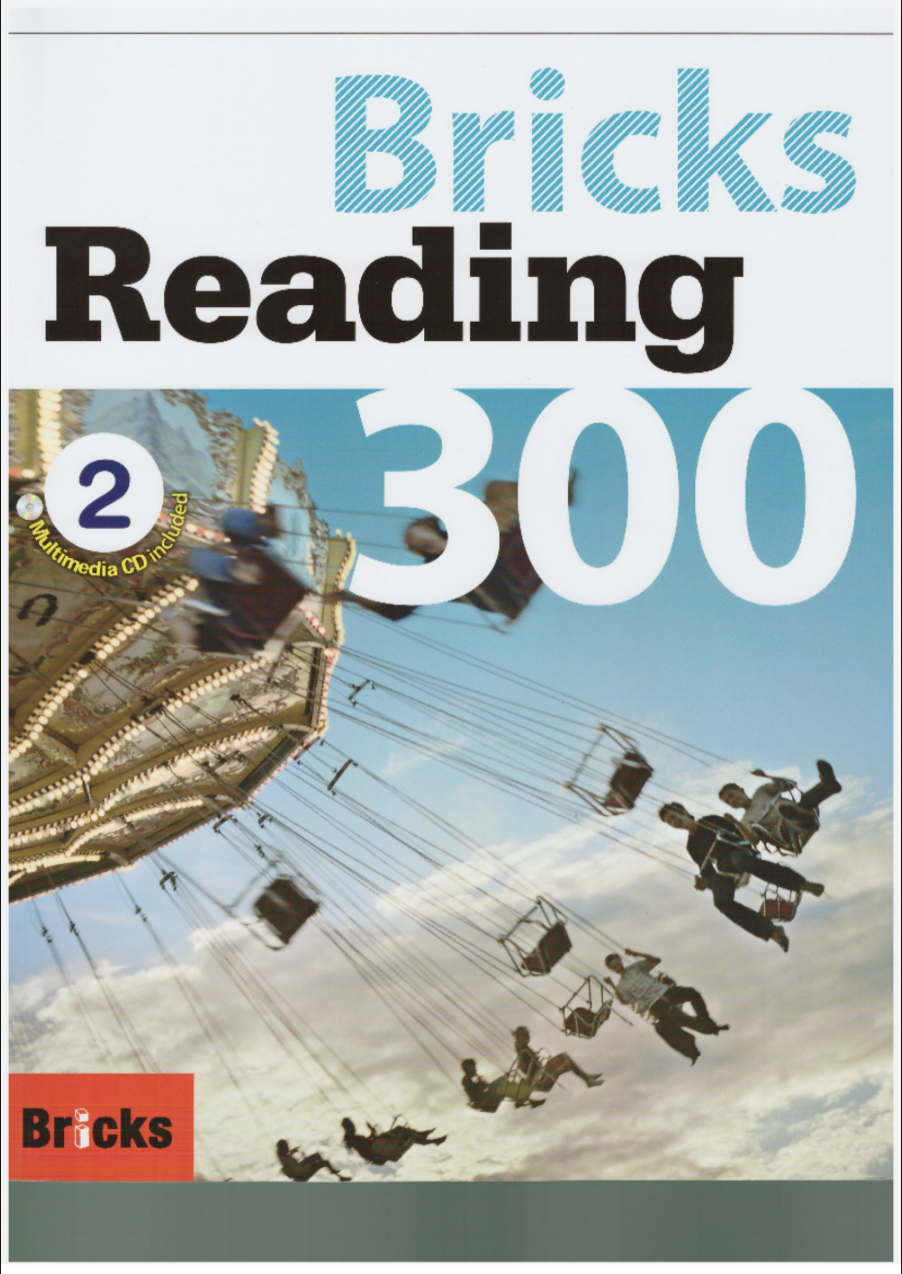
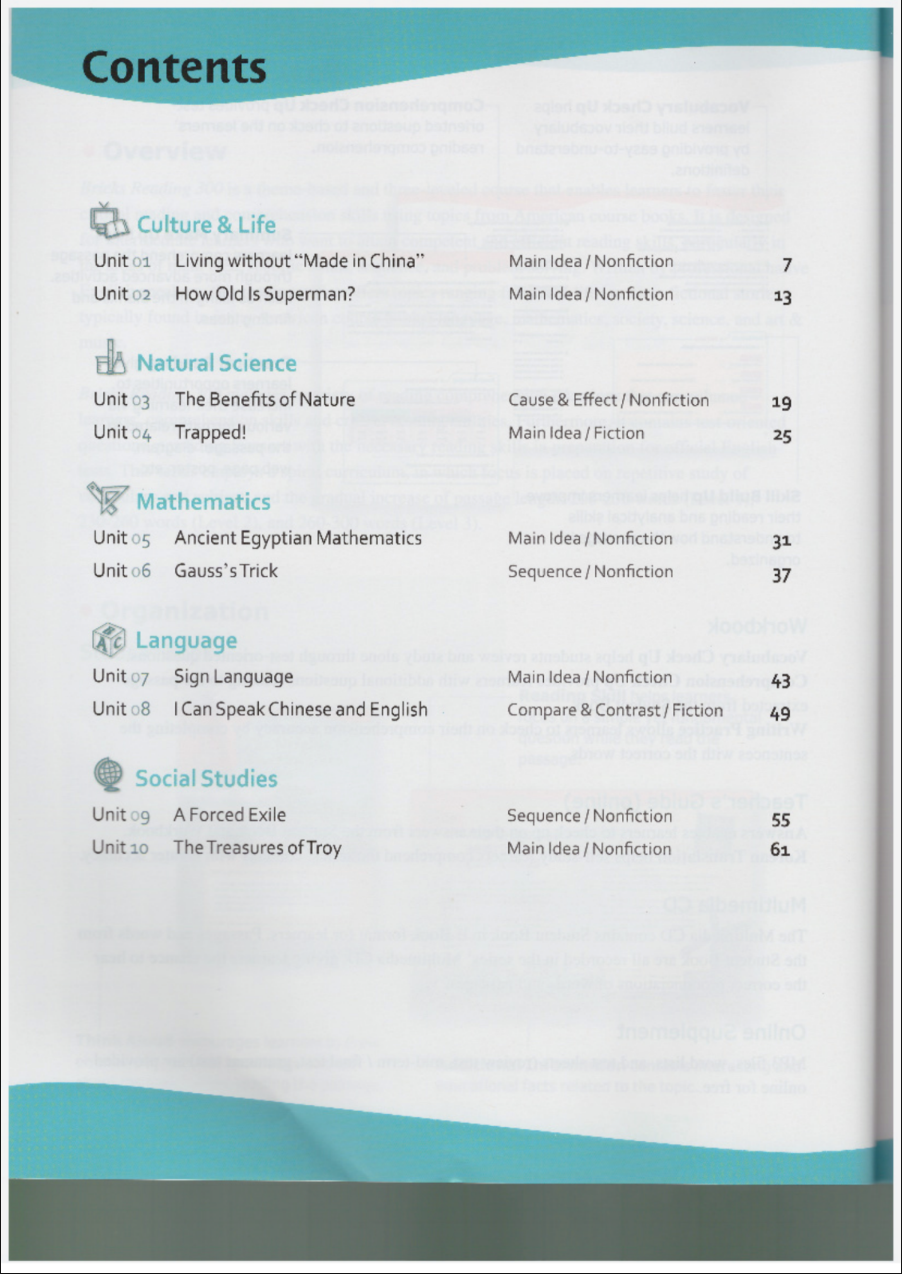
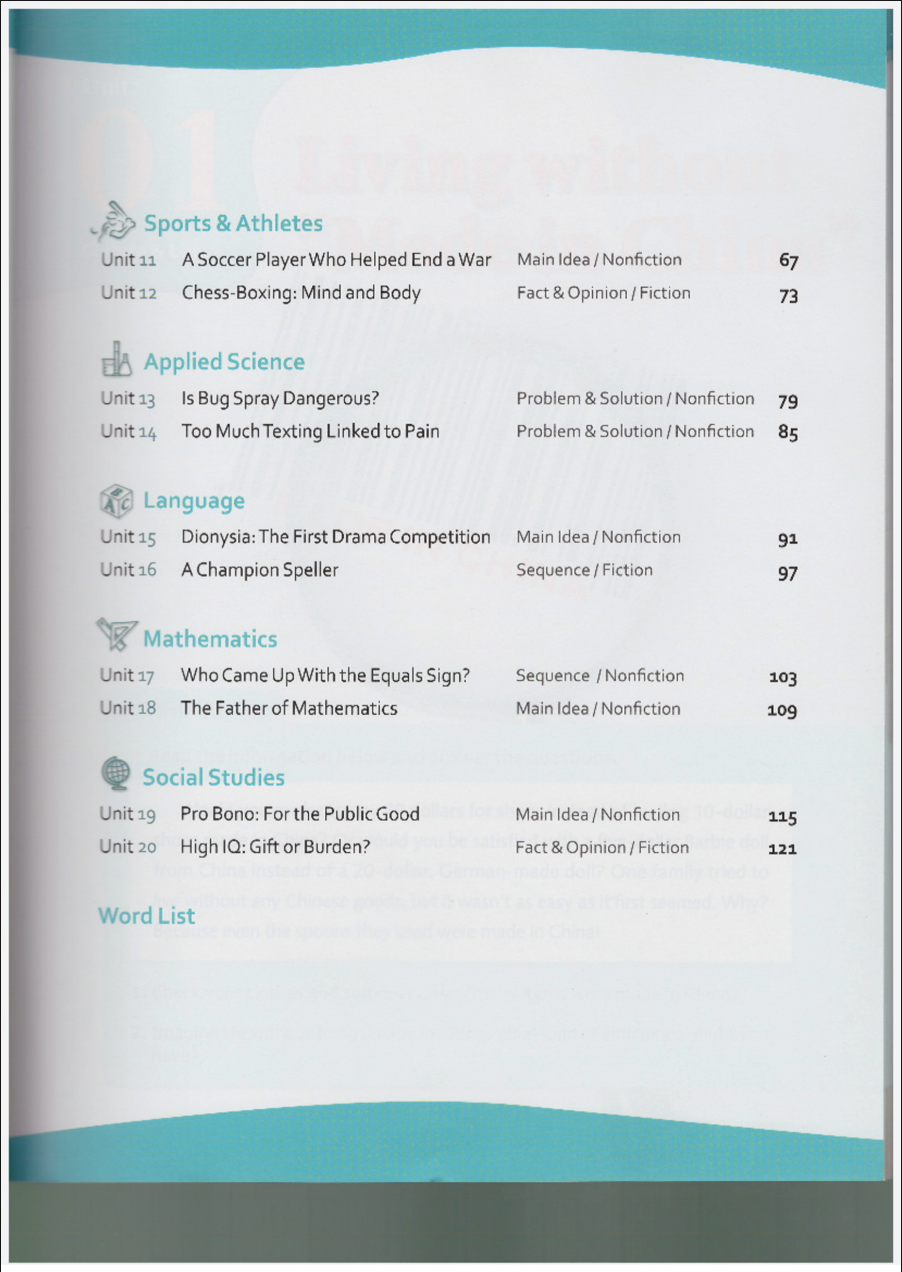




Bricks Reading 300 Student 2Culture & LifeUnit 01 Living without “Made in China” (Main Idea/Nonfiction) 7Unit 02 How Old Is Superman? (Main Idea/Nonfiction) 13Natural ScienceUnit 03 The Benefits of Nature (Cause & Effect/Nonfiction) 19Unit 04 Trapped! (Main Idea/Fiction) 25MathematicsUnit 05 Ancient Egyptian Mathematics (Main Idea/Nonfiction) 31Unit 06 Gauss’s Trick (Sequence/Nonfiction) 37LanguageUnit 07 Sign Language (Main Idea/Nonfiction) 43Unit 08 I Can Speak Chinese and English (Compare & Contrast/Fiction) 49Social StudiesUnit 09 A Forced Exile (Sequence/Nonfiction) 55Unit 10 The Treasures of Troy (Main Idea/Nonfiction) 61Sports & AthletesUnit 11 A Soccer Player Who Helped End a War (Main Idea/Nonfiction) 67Unit 12 Chess-Boxing: Mind and Body (Fact & Opinion/Fiction) 73Applied ScienceUnit 13 Is Bug Spray Dangerous? (Problem & Solution/Nonfiction) 79Unit 14 Too Much Texting Linked to Pain (Problem & Solution/Nonfiction) 85Language (Part 2)Unit 15 Dionysia: The First Drama Competition (Main Idea/Nonfiction) 91Unit 16 A Champion Speller (Sequence/Fiction) 97Mathematics (Part 2)Unit 17 Who Came Up With the Equals Sign? (Sequence/Nonfiction) 103Unit 18 The Father of Mathematics (Main Idea/Nonfiction) 109Social Studies (Part 2)Unit 19 Pro Bono: For the Public Good (Main Idea/Nonfiction) 115Unit 20 High IQ: Gift or Burden? (Fact & Opinion/Fiction) 121Word List 127 |
The Intellectual Bridge: A Comprehensive Review of the Advanced Content-Based Reading Guide
Introduction: Engineering Academic Literacy through Inquiry
In the higher stages of elementary and middle-school education, reading is no longer just about decoding; it is the primary engine for acquiring specialized world knowledge. “The Intellectual Bridge” (from the Bricks Reading 300 series) is a masterfully designed pedagogical roadmap specifically engineered to guide learners through the transition from general reading to advanced academic literacy.
This guide transforms the study of English into a series of masterable, high-interest milestones across seven distinct scientific and social domains. By deconstructing complex texts—from Egyptian mathematics to global trade logistics—this book provides the “X-ray vision” needed for students to become confident, analytical readers.
What Kind of Book Is This?
This is a Comprehensive Content and Language Integrated Learning (CLIL) Curriculum for intermediate-to-advanced elementary students. It functions as a multidisciplinary reference guide that bridges the gap between language arts and subject-area expertise (Science, Math, Social Studies).
The book follows a logical, tripartite architecture—mapping every unit to a specific academic theme and a target reading skill (e.g., “Fact vs. Opinion” or “Problem & Solution”)—ensuring that students build a cohesive understanding of how English functions as a global medium of instruction.
Who Is the Ideal Reader?
- Intermediate Elementary Students: Learners who have mastered basic fluency and are ready to tackle complex academic topics and longer passage lengths.
- English Language Learners (ESL/EFL): Advanced students seeking an authoritative framework to master technical vocabulary and formal American English text structures.
- CLIL and International Educators: Teachers looking for a “plug-and-play” curriculum that covers multiple standards—from history and biology to ethics and sports—within a single literacy block.
- Homeschooling Families: Those who need a diverse toolkit of thematic lessons that align with rigorous international academic standards.
Detailed Editorial Review: Why This Book Is a Game-Changer
1. Strategic Cross-Curricular Scaffolding
The standout feature of this manual is its Intellectual Breadth. It understands that children learn best when they are challenged by real-world concepts. By alternating between “Natural Science” and “Mathematics” or “Culture & Life”, the book ensures that the learning process remains high-interest and prevents cognitive fatigue. This holistic approach is scientifically proven to improve vocabulary retention by anchoring words in meaningful, academic contexts.
2. Mastery of Critical Analytical Skills
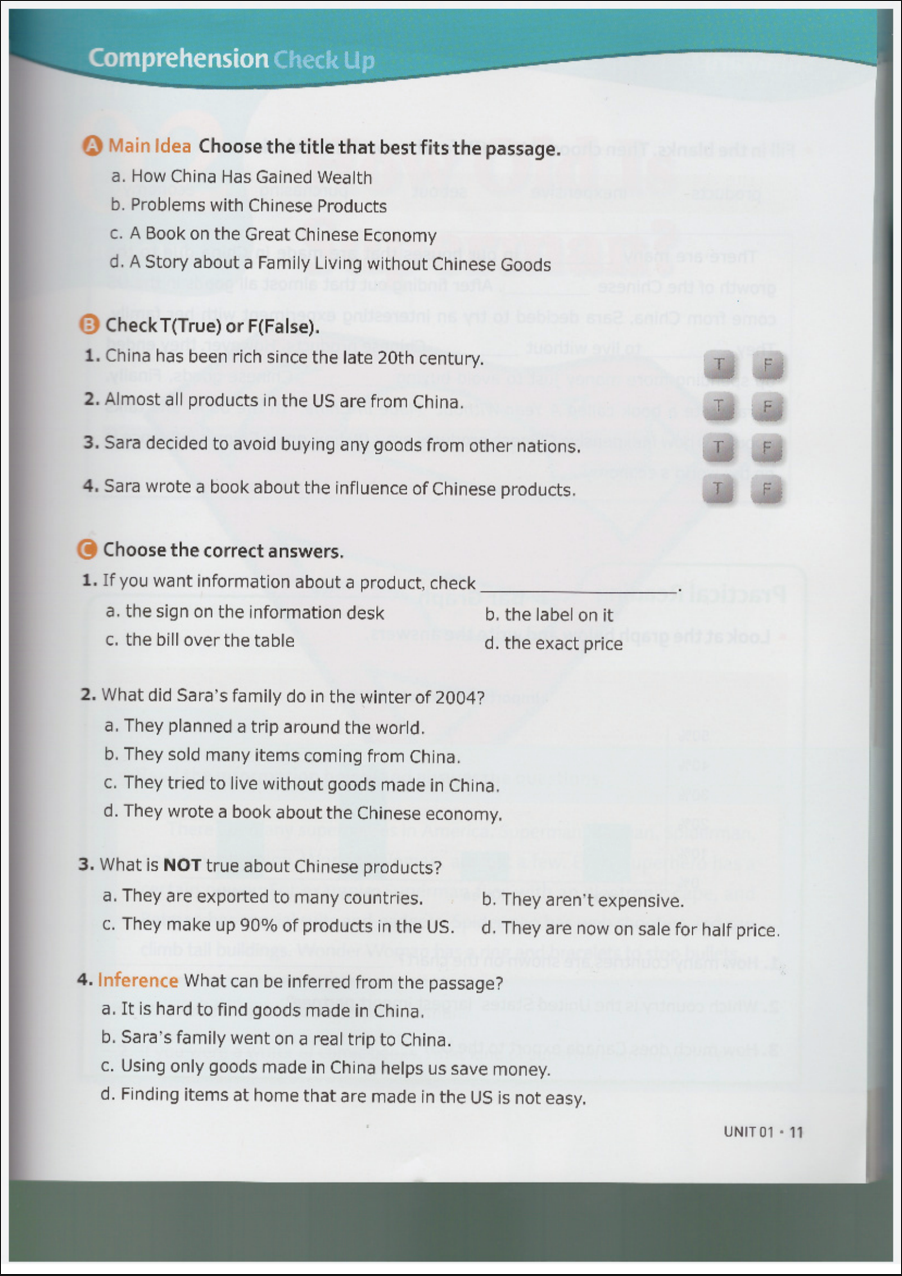
Unlike generic readers, this guide dedicates every unit to a Specific Cognitive Tool. Whether it is identifying the “Main Idea” in a story about Superman or analyzing “Cause & Effect” in natural biology, the manual provides a definitive solution to comprehension gaps. It teaches students to look at a text not just as a narrative, but as a data-rich environment to be analyzed and synthesized.
3. Sophisticated Integration of Nonfiction and Fiction
The curriculum respects the diverse ways information is presented. By pairing rigorous Nonfiction reports (like “The Treasures of Troy”) with thematic Fiction (like “Trapped!”), the manual provides the “X-ray vision” needed for students to identify text structures across genres. This multidisciplinary approach effectively doubles the educational impact of every study session.
4. Real-World Relevance and Global Citizenship
The inclusion of modern, high-stakes themes—such as “Living without ‘Made in China'” or “Too Much Texting”—is a brilliant, practical touch. It acknowledges that literacy is the foundation of Functional Citizenship. By providing students with the linguistic tools to discuss trade, health technology, and social service (Pro Bono), the guide empowers the student to use English as a tool for global participation.
The Final Verdict: Why You Must Read It
You should implement this book because academic literacy is the foundation of authority. For an intermediate learner, the English language is a journey toward professional and scientific understanding; this guide ensures that every one of those 20 strategic leaps is meaningful, measurable, and intellectually rewarding.
Final Conclusion: Rigorous, logically organized, and profoundly practical, this is the gold standard for content-based reading instruction. It celebrates the joy of discovery while maintaining a high standard of academic excellence. If you are serious about building a literate, curious, and academically confident student body, “Bricks Reading 300” is an indispensable investment.