

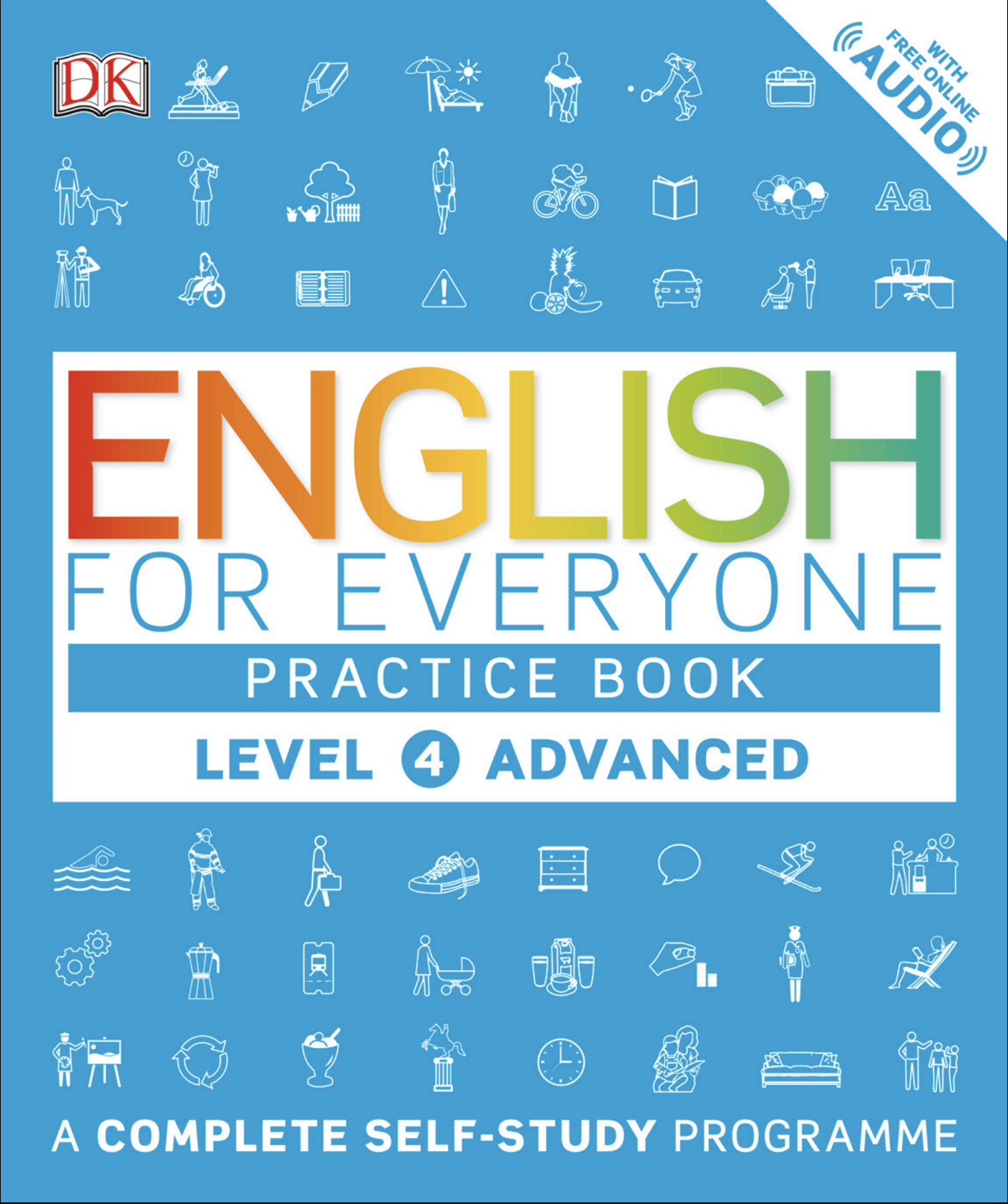
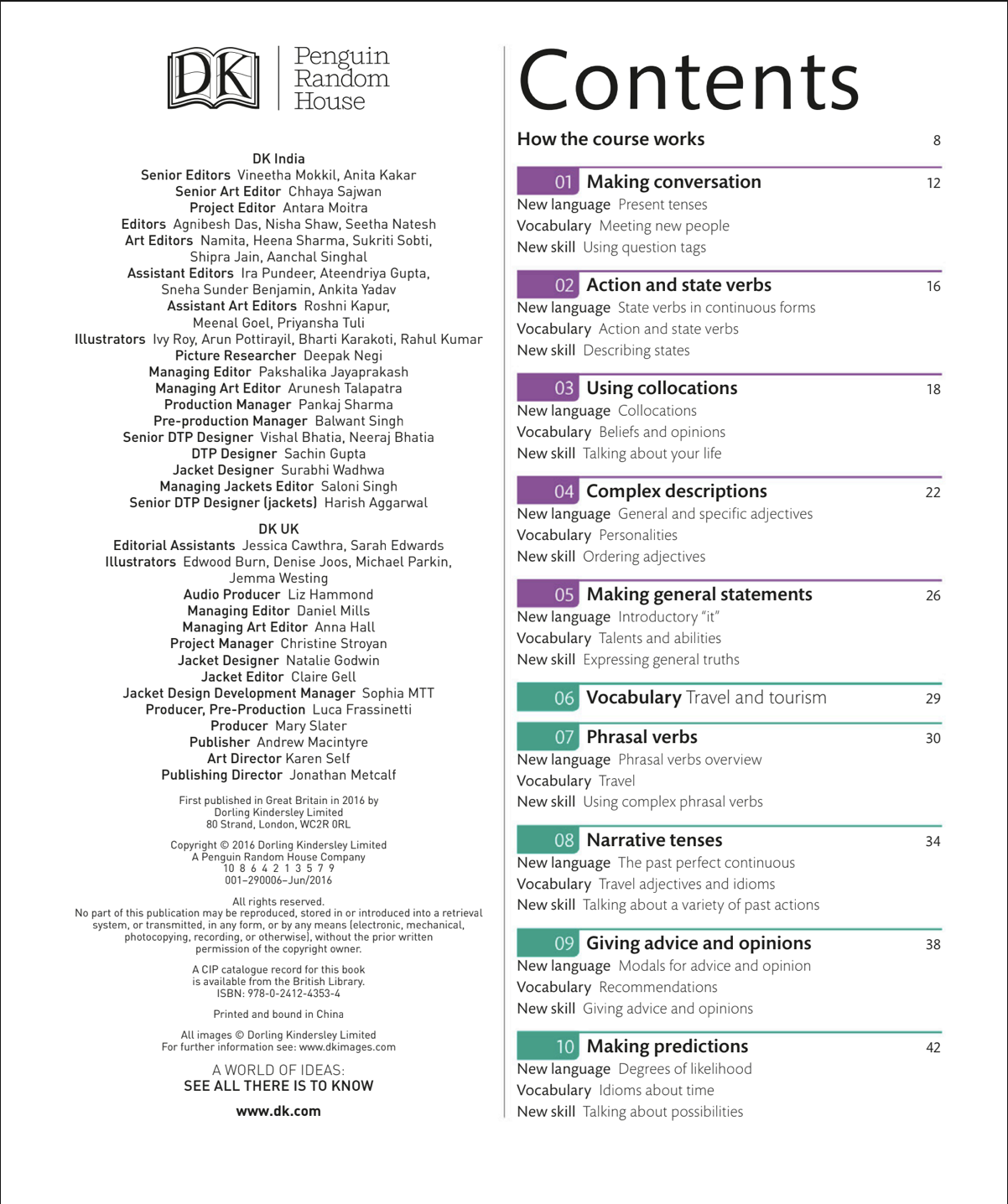



English For Everyone Practice Book Level 4How the course works 801 Making conversation 12Language: Present tenses | Vocab: Meeting new people | Skill: Question tags02 Action and state verbs 16Language: Continuous forms | Vocab: Action/state verbs | Skill: Describing states03 Using collocations 18Language: Collocations | Vocab: Beliefs and opinions | Skill: Talking about life04 Complex descriptions 22Language: Ordering adjectives | Vocab: Personalities | Skill: Specific adjectives05 Making general statements 26Language: Introductory “it” | Vocab: Talents and abilities | Skill: General truths06 Vocabulary: Travel and tourism 2907 Phrasal verbs 30Language: Phrasal verbs overview | Vocab: Travel | Skill: Complex phrasal verbs08 Narrative tenses 34Language: Past perfect continuous | Vocab: Idioms | Skill: Past actions09 Giving advice and opinions 38Language: Modals | Vocab: Recommendations | Skill: Advice and opinions10 Making predictions 42Language: Degrees of likelihood | Vocab: Time idioms | Skill: Possibilities11 Vocabulary: Family and relationships 4512 Using discourse markers 46Language: Linking information | Vocab: Family history | Skill: Relationships13 Past habits and states 50Language: “Used to” and “would” | Vocab: Values | Skill: Past vs. Present14 Comparing and contrasting 54Language: “As… as” | Vocab: Collocations | Skill: Contrasting15 Two comparatives together 58Language: Double comparatives | Vocab: Population | Skill: Cause and effect… [Units 16 – 60 skipping for brevity] …61 Vocabulary: Art and culture 20362 Leaving words out 204Language: Ellipsis | Vocab: Entertainment | Skill: Avoiding repetition63 Substituting words 208Language: Substitution | Vocab: Books and reading | Skill: Replacing phrases64 Shortening infinitives 212Language: Reduced infinitives | Vocab: Performance | Skill: Nuanced speech65 Expressing reactions 216Language: Discourse markers | Vocab: Prefixes | Skill: Structuring conversation66 Getting things done 220Language: Causative “have/get” | Vocab: Services | Skill: Describing tasks67 Complex agreement 224Language: Subject-verb agreement | Vocab: Collective nouns | Skill: Accuracy68 “So” and “such” 228Language: Emphasis | Vocab: Medical science | Skill: Detailed descriptions69 Using articles to generalize 232Language: Generic “the” | Vocab: Exploration | Skill: Advanced articles |
The Professional Communicator: A Comprehensive Review of the Advanced English Mastery Guide
Introduction: Engineering the Path to Near-Native Fluency
In the globalized professional landscape, the leap from “functional” to “sophisticated” English is often the most difficult stage of language acquisition. “The Professional Communicator” is a masterfully designed pedagogical roadmap specifically engineered to guide advanced learners through the complex nuances of American English.
This manual moves beyond basic grammar, transforming high-level linguistic concepts into a series of masterable, high-interest milestones. From the architectural precision of “Narrative Tenses” to the subtle social cues of “Indirect Statements,” this guide provides the tools necessary to turn an advanced student into an authoritative, confident speaker.
What Kind of Book Is This?
This is a Comprehensive Multi-Dimensional Advanced English Curriculum designed for upper-intermediate to advanced learners (CEFR B2-C1). It functions as a multidisciplinary reference guide that integrates complex grammar, specialized vocabulary, and high-level communication skills.
The book follows a logical, modular architecture—dedicating 69 units to everything from workplace psychology and legal terms to medical science and environmental threats—ensuring that students build a cohesive understanding of how English is utilized in professional and academic spheres.
Who Is the Ideal Reader?
- Business Professionals and Executives: Those looking for a “plug-and-play” reference to ensure their emails, presentations, and negotiations meet the highest standards of professional excellence.
- University Students & Academic Researchers: Individuals seeking an authoritative, evidence-based framework to master academic writing, note-taking, and complex debate.
- English Language Learners (ESL): Advanced students aiming to eliminate persistent “intermediate-plateau” errors and master idiomatic American expressions.
- Tutors and Trainers: Professionals who need a diverse toolkit of thematic lessons that cover real-world topics like “Job Applications,” “Speculation,” and “Crime and the Law.”
Detailed Editorial Review: Why This Book Is a Game-Changer
1. Strategic Integrated Learning Model
The standout feature of this manual is its Tri-Pillar Approach. Every unit simultaneously targets “New Language” (Grammar), “Vocabulary” (Context), and “New Skill” (Application). By learning “Third Conditionals” specifically within the context of “Environmental Threats,” the book ensures that grammar is never learned in a vacuum. This multidisciplinary method is scientifically proven to improve long-term retention and functional fluency.
2. Mastery of Linguistic Nuance and Emphasis
Unlike generic textbooks, this guide excels in teaching the “Subtleties of Power.” Entire units are dedicated to “Changing Emphasis” (Unit 19), “Shifting Focus” (Unit 45), and “Qualifying Descriptions” (Unit 29). These lessons provide the definitive solution to “flat” communication, empowering the student to use language to persuade, negotiate, and react with professional-grade precision.
3. Real-World Career Integration
The curriculum respects the professional needs of the modern learner. By including intensive modules on “Job Applications” (Unit 22), “Meeting and Planning” (Unit 28), and “Reporting with Passives” (Unit 42), the manual transforms the classroom into a high-stakes professional laboratory. This direct application to a career path is what separates this series from purely academic resources.
4. Sophisticated Vocabulary Breadth
The inclusion of 69 diverse thematic pillars—ranging from “Tradition and Superstition” to “Medical Science”—is a vital pedagogical asset. It provides the “X-ray vision” needed for students to navigate a variety of professional environments without hesitation. The focus on “Collocations,” “Phrasal Verbs,” and “Discourse Markers” ensures that the learner’s speech remains rhythmic, natural, and rhythmic.
The Final Verdict: Why You Must Read It
You should implement this book because clarity in advanced communication is the foundation of authority. For an advanced learner, the English language is no longer a set of rules but a tool for influence; this guide ensures that every lesson is a strategic leap toward professional success.
Final Conclusion: Rigorous, logically organized, and profoundly practical, this is the gold standard for advanced English instruction. It celebrates the complexity of the language while maintaining a high standard of functional excellence. If you are serious about building a persuasive, sophisticated, and professional voice, this book is an indispensable investment.