
![[FREE] N5 Municipal Administration Lecturer Guide Ebook Dowload PDF](https://freeebooksonline.com/wp-content/uploads/elementor/thumbs/Screenshot-2026-04-20-at-10.27.43-rmb78ntwjs0wja50ue1hudwe05wczn4dlvwouea2mw.png "[FREE] N5 Municipal Administration Lecturer Guide Ebook Dowload PDF")



Contents
Module 1 Development of local authorities | 1 |
Module 2 The reason for existence of municipal authorities | 5 |
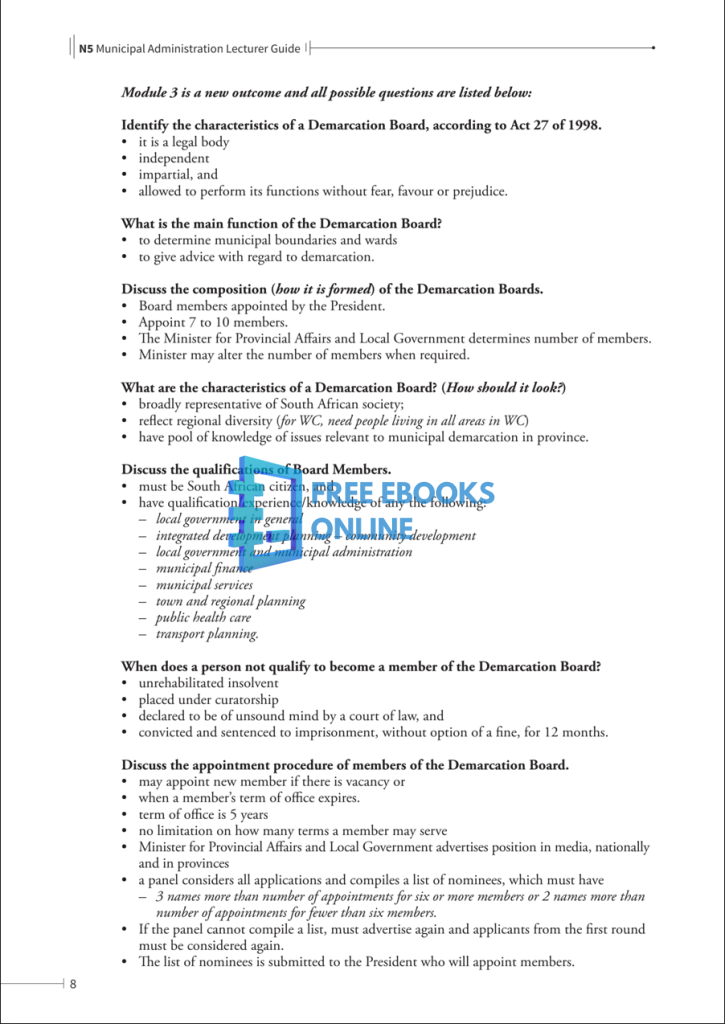
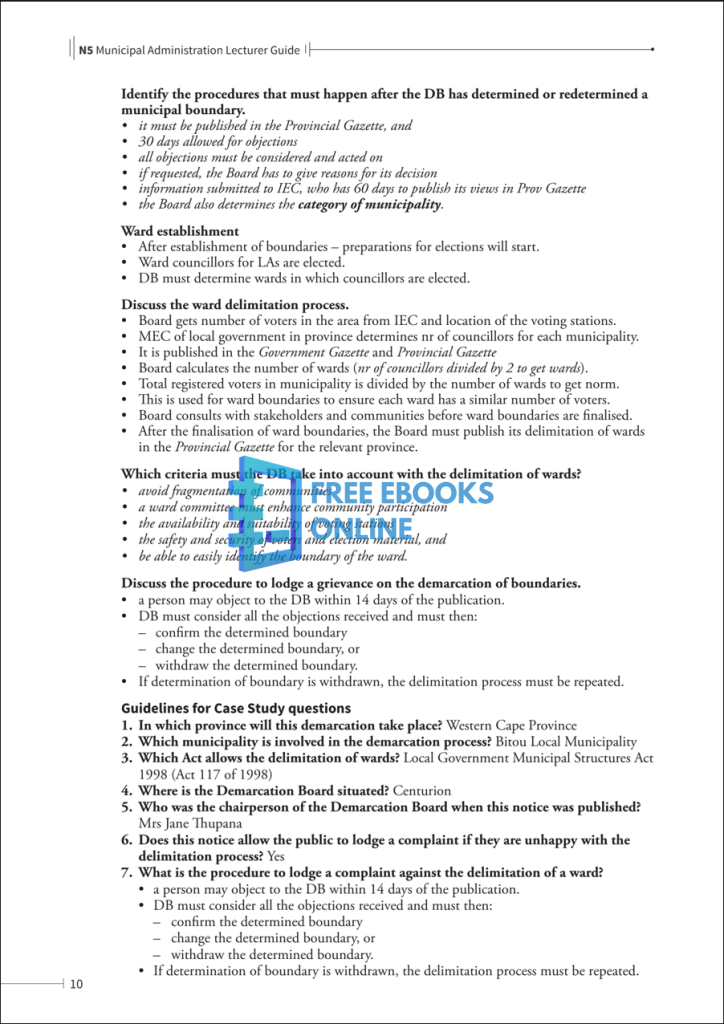
Module 3 Determining municipal boundaries | 7 |
Module 4 Environmental factors influencing services | 17 |
Module 5 Levels of government and municipal co-operation | 23 |
Module 6 Powers and functions of municipalities | 29 |
Module 7 Services rendered by municipalities | 35 |
Module 8 Municipal elections | 43 |
Module 9 Municipal councillors | 49 |
Module 10 Office-bearers of municipalities | 55 |
Module 11 Committee system municipalities | 59 |
Module 12 Meeting procedures of municipalities | 65 |
Mock examination questions | 73 |
Introduction to “Municipal Administration: A Comprehensive Lecturer’s Guide”
Municipal Administration is far more than a technical manual on bureaucracy; it is a definitive, scholarly, and highly practical roadmap to the heartbeat of democracy: local government. This guide serves as a critical bridge between theoretical public policy and the day-to-day realities of governing a community. Designed as a modular curriculum, it takes the reader from the historical evolution of local authorities to the complex, modern-day procedures required to run a city council. It is built on the belief that effective local governance is the most direct way to improve the lives of citizens.
Who Is This Book For?
This book is an indispensable resource for a wide range of professionals and students:
- Academic Instructors & Lecturers: It is perfectly structured as a primary teaching tool for university-level courses in Public Administration, Political Science, or Urban Planning.
- Public Administration Students: Individuals seeking to understand the structural logic, legal powers, and functional responsibilities of local government.
- Newly Elected Officials & Councillors: A “survival guide” for those entering public office who need to master meeting protocols, committee systems, and their legal mandates.
- Civil Servants & Policy Makers: Professionals working within the government hierarchy who need a clear understanding of inter-governmental cooperation and service delivery.
Detailed Review: Why This Book Stands Out
1. A Logical, Modular Progression
Most administrative texts are dense and difficult to navigate. This guide masterfully avoids that pitfall by using a modular structure. It begins with the “Why” (the development and reason for existence of local authorities) before moving into the “How” (elections, powers, and procedures). This step-by-step approach ensures that even complex topics like boundary determination or inter-governmental cooperation are easily understood.
2. Emphasis on Contextual Governance
What makes this guide truly special is Module 4: Environmental Factors Influencing Services. Unlike many textbooks that treat administration in a vacuum, this book acknowledges that geography, demographics, and social environments dictate how services are rendered. It teaches administrators to be responsive to their specific local context rather than following a “one-size-fits-all” model.
3. Operational Precision and “The Rules of the Game”
The book shines in its attention to the “nuts and bolts” of governance. The final modules on the Committee System and Meeting Procedures are invaluable. They provide the procedural clarity necessary for a transparent and functioning democracy, ensuring that meetings are not just gatherings, but legally sound, productive decision-making sessions.
4. Pedagogical Excellence and Exam Readiness
The guide is designed with the educator in mind. The inclusion of Mock Examination Questions at the end provides a ready-made assessment framework. It allows lecturers to test not just the students’ memorization, but their ability to apply administrative principles to real-world scenarios.
Final Verdict: Why You Should Read It
If you have ever been frustrated by the inefficiency of local government or felt overwhelmed by the complexity of public service, this book is your solution. “Municipal Administration” demystifies the “black box” of local politics without oversimplifying the weight of the responsibility. It is an essential resource that proves that good governance is not an accident—it is the result of disciplined, informed, and ethical administration.
Whether you are preparing for a career in public service or are responsible for training the next generation of leaders, this guide is a must-have addition to your professional library. It arms you with the knowledge to turn public policy into public impact.