N5 Mathematics is one of the EBook worth reading and referencing. Free Ebooks Online is currently sharing N5 Mathematics for free as a PDF file.
=> Click the Download PDF button below to download N5 Mathematics to your computer!
No keywords available. Please create some keywords in the admin.
Description this Book
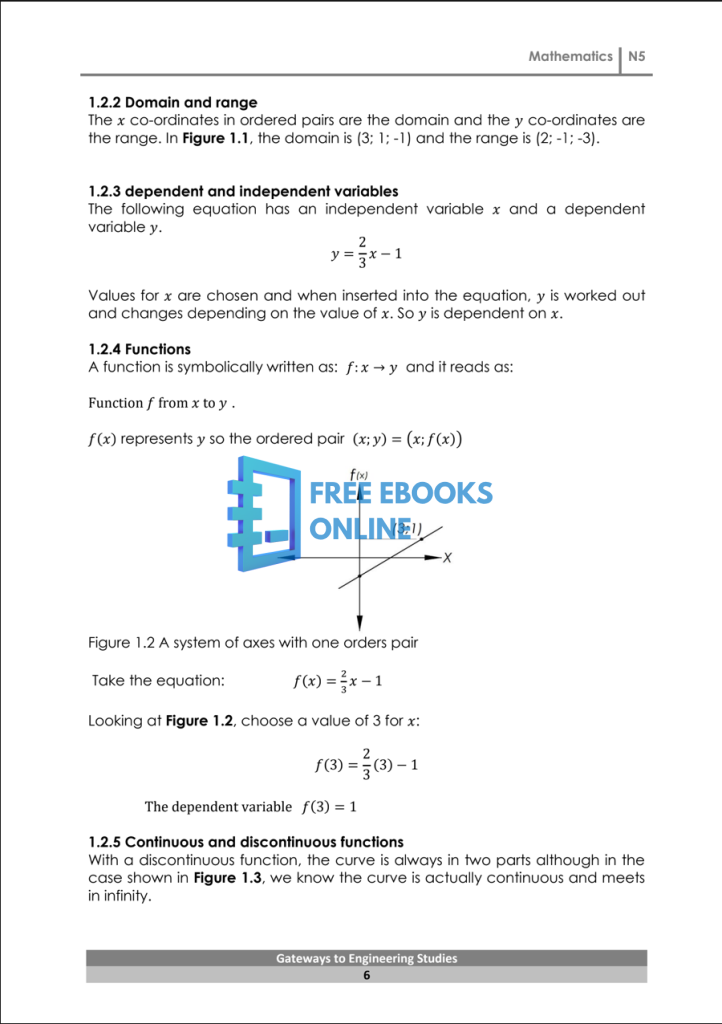
To help you get an overview and become familiar with the content, our editorial team has included a short excerpt from the book below. If you would like to read the full work, please click the “Download PDF Now” button above to get the complete version for free.
Mathematics | N5
Table of Contents
Module 1:
Limits and Continuity …………………………………………….
5
1.1 Introduction …………………………………………………………………….
5
1.2 The function ……………………………………………………………………..
5
1.2.1 System of axes and ordered pairs ……………………………..
5
1.2.2 Domain and range ………………………………………………………
6
1.2.3 dependent and independent variables …………………………
6
1.2.4 Functions …………………………………………………………………….
6
1.2.5 Continuous and discontinuous functions ……………………..
6
1.2.6 Functions and relations ………………………………………………
7
1.2.7 Inverse functions ………………………………………………………..
7
1.3 Limits …………………………………………………………………………………..
8
1.3.1 Increments ………………………………………………………………………
8
1.3.2 The concept of the limit ……………………………………………….
8
1.3.3 A limit in the form 0/0 ………………………………………………..
11
1.3.4 L Hospital’s rule …………………………………………………………..
12
Module 2:
Differentiation …………………………………………………………………
19
2.1 Introduction …………………………………………………………………….
19
2.2 Differentiation from first principles …………………………………..
19
2.2.1 Differentiate … functions in the form fx = axⁿ …………….
19
2.2.2 Differentiate … in the form fx = a ± bxc ± dx ……………
20
2.2.3 Differentiate … in the form sinx and cosx ………………….
3.2 Determine the roots of cubic polynomials ……………………………..
42
3.3 Determine the Turning points of cubic polynomials ……………….
45
3.4 Rates of change …………………………………………………………………….
54
3.4.1 Velocity and acceleration ……………………………………………..
54
3.4.2 Related rates of change ………………………………………………..
55
Module 4:
Integration Techniques ……………………………………………………..
66
4.1 Introduction …………………………………………………………………….
67
4.2 Indefinite integrals …………………………………………………………….
67
4.3 Substitution to transform composite functions ……………………..
71
4.6 Algebraic fractions ………………………………………………………………
75
Module 5:
Application of the Definite Integral ………………………………….
89
5.1 Introduction …………………………………………………………………….
89
5.2 The area between two curves ………………………………………………
94
5.3 Second moment of area ………………………………………………………
102
Module 6:
Differential Equations ………………………………………………………
114
6.1 Introduction …………………………………………………………………….
114
6.2 General and particular solutions of differential equations ……..
115
Past Examination Papers …………………………………………………..
122
Introduction: Mastering the Language of Engineering
Mathematics is the cornerstone of every engineering breakthrough, and “Gateways to Engineering Studies: Mathematics N5” serves as the definitive roadmap for students entering the rigorous world of technical analysis. This is not merely a collection of formulas; it is a structured, comprehensive curriculum designed to transition students from foundational concepts to advanced calculus. By focusing on the “Gateways” approach, the text ensures that every mathematical theory is anchored in logical progression, preparing the next generation of engineers for the complexities of the physical world.
Detailed Review: A Deep Dive into Calculus and Application
What Kind of Book Is This?
This is a technical academic textbook specialized in Higher Engineering Mathematics. It follows a modular structure that prioritizes Calculus—the mathematical study of continuous change. The book is designed to function as both a classroom primary text and a self-study reference for those tackling the N5 level of engineering mathematics.
Who Is the Ideal Reader?
Engineering Aspirants: Specifically those enrolled in TVET (Technical and Vocational Education and Training) or university-preparatory engineering tracks.
STEM Students: Anyone needing a rigorous deep-dive into limits, derivatives, and integrals.
Technical Professionals: Individuals looking to refresh their understanding of differential equations and second moments of area for structural or mechanical applications.
What Makes This Book Special?
Logical Scaffolding: The book starts with “Limits and Continuity”—the conceptual “soul” of calculus—before moving into the “mechanics” of differentiation and integration. This ensures readers don’t just memorize rules like the Chain Rule or L’Hospital’s Rule but understand the why behind them.
Engineering Integration: Unlike general math books, this text bridges the gap between pure mathematics and physical reality. Module 5, for instance, focuses on the “Second Moment of Area,” a critical concept in structural engineering and beam theory that is often overlooked in standard calculus texts.
Algorithmic Clarity: The breakdown of “Differentiation from First Principles” (Module 2) is exceptionally clear, moving from simple polynomials to complex trigonometric and implicit functions in a way that builds student confidence.
Why Is It Worth Reading?
In the world of engineering, “almost correct” is not enough. This book is worth your time because it emphasizes accuracy and procedural mastery.
Exam Readiness: With a dedicated section for “Past Examination Papers,” the book aligns directly with academic standards, ensuring that what you learn is exactly what you will be tested on.
Practical Utility: Whether it’s calculating “Rates of Change” in velocity and acceleration or solving “Differential Equations,” the book provides the exact tools required for advanced physics and mechanical engineering courses.
Final Verdict
“Gateways to Engineering Studies: Mathematics N5” is a pragmatic, high-caliber guide. It strips away the fluff and focuses on the high-level competencies required in the engineering industry. If you want to master the mathematical frameworks of the modern world, this book is an indispensable addition to your library. It transforms daunting equations into a powerful set of tools for your professional future.

![N5 Mathematics Ebook Dowload PDF [FREE]](https://freeebooksonline.com/wp-content/uploads/elementor/thumbs/Screenshot-2026-04-20-at-13.58.57-rmb78bm02xk6ccmrtqrcfyzea5kl7krv87fdlss6vs.png "N5 Mathematics Ebook Dowload PDF [FREE]")